
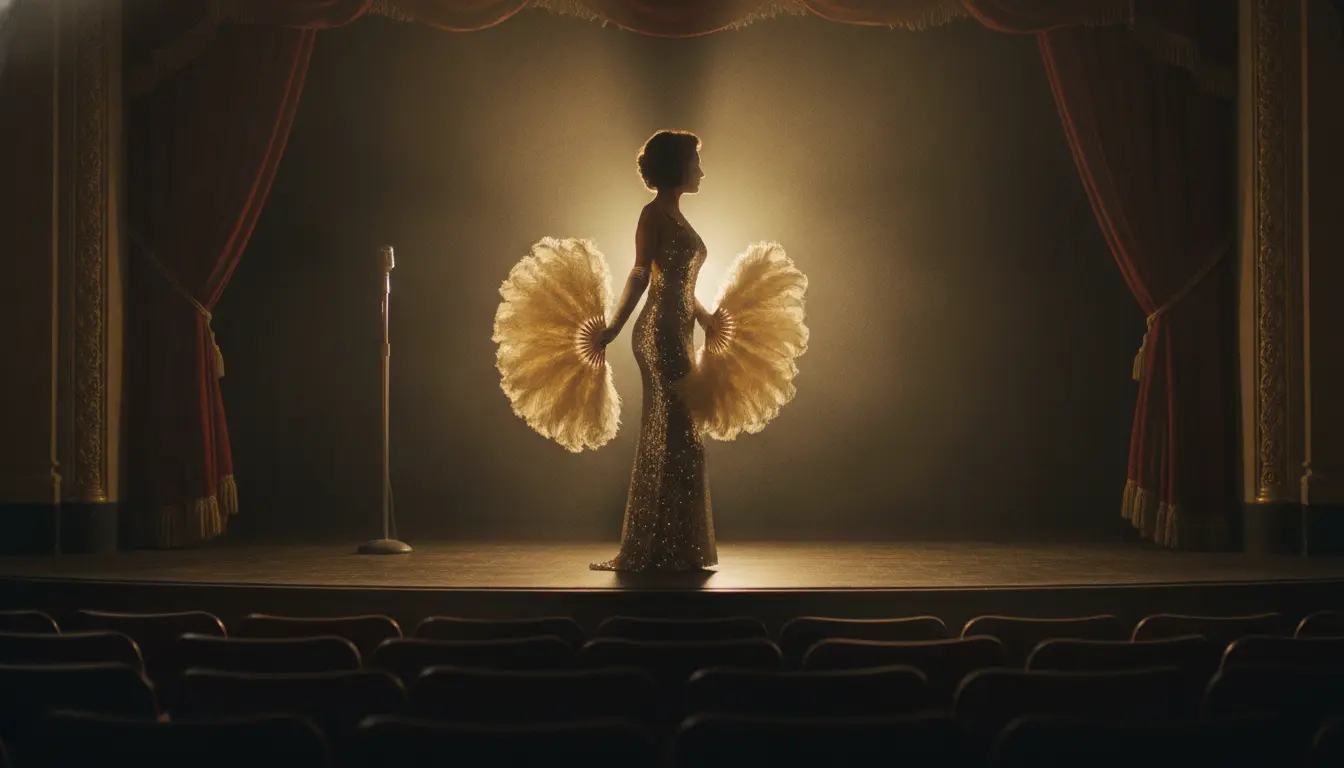
Long before poles, private booths and card machines, striptease was a stage art built around a censor’s rulebook. Between the early 1950s and the late 1960s, a handful of venues and performers in London, Paris and the United States set the template that clubs still borrow from today. Here is how the vintage era worked, and why it ended so quickly.
London: when the law said nobody could move
To understand classic British striptease, start with the censor. Until 1968, every public stage play in Britain needed a licence from the Lord Chamberlain’s Office. Nudity was not banned outright, but it came with a famous condition: if it moves, it’s rude.
The Windmill Theatre on Great Windmill Street turned that rule into a business model. The theatre opened in 1931 under owner Laura Henderson and manager Vivian Van Damm, and it became known for its “living statues”, or tableaux vivants. As former Windmill Girls told the Camden New Journal at a 2018 reunion, the posed performers had to stay completely still. Only the principal fan dancers were allowed to move. The performers were trained singers and dancers, the bill included comedians and variety acts, and the company ran six shows a day.
The Windmill’s slogan was “We never closed”, a reference to keeping the show going through the Blitz. The decline came later. According to London Walks, Sheila Van Damm, who took over after her father died in 1960, blamed the arrival of strip clubs from 1956, along with commercial television and X-rated films, for the falling audiences. The Windmill closed on 31 October 1964 and reopened as a cinema two days later.
Soho goes private: the Revuebar model
The man who did most to change Soho was Paul Raymond. He opened the Raymond Revuebar in Walker’s Court in 1958, and, as Chortle noted in its 2008 obituary, it was at the time the only venue in Britain staging live strip shows.
The trick was legal rather than artistic. By operating as a members-only club, the Revuebar sat outside the public-theatre rules that kept the Windmill’s performers frozen in place, according to its history on Wikipedia. Members paid to join, and performers could move.
The Revuebar had a long run. It traded under the Raymond name until 2004, and the building later became a comedy and cabaret venue. The format it pioneered, a membership club with a door policy and a show, is an early version of the modern gentlemen’s club.
Paris: Crazy Horse and striptease as design
Paris had long had its revues at the Moulin Rouge and the Folies Bergère, built on feathers, chorus lines and spectacle. In 1951 the artist Alain Bernardin opened something smaller and sharper: Crazy Horse, in former wine cellars on Avenue George V, just off the Champs-Élysées.
According to the South China Morning Post, Bernardin was fascinated by American burlesque and set out to turn the Paris cabaret show into an art form. He chose the music himself and sketched costumes. The venue drew an artistic crowd; the same report names Andy Warhol and Salvador Dalí among its early guests.
That attention to stagecraft still defines the venue. The same report says Crazy Horse hires classically trained dancers, puts them through three months of training after audition, and caps their height at 173 cm because the stage is so small. Christian Louboutin has designed shoes and a show with the company since 2007, and in 2023 the revue was still running, with guest performers from the pop world.
America’s headliners: burlesque at its peak
In the United States, the 1950s were the final peak of burlesque. Strip acts sat on variety bills in theatres and nightclubs, and the biggest names were genuine stars.
Tempest Storm is the clearest example. Born Annie Blanche Banks, she began working at the Follies Theater in Los Angeles in 1951. By 1956, according to her obituary on Legacy.com, she was the highest-paid burlesque performer in history, earning around $100,000 a year. She went on to headline on the Las Vegas Strip and kept performing until 2010. She died in Las Vegas in April 2021, aged 93.
Storm’s name usually comes up alongside Lili St. Cyr, Blaze Starr and Gypsy Rose Lee. What linked them was showmanship. In a 1968 interview with the critic Roger Ebert, quoted in the same obituary, Storm explained that the secret of a good act was to leave as much as possible to the imagination. She said she put on more clothes during her act than she took off. A performer who could suggest modesty, in her view, held an audience far better than one who simply undressed.
That idea, the tease rather than the strip, is the core of what people now call classic or vintage striptease.
1964: the year the old rules began to break
Several things happened in 1964 that, looking back, mark the end of the era.
In London, the Windmill closed. In San Francisco, Carol Doda performed topless at the Condor Club on Broadway. The Associated Press reported in her 2015 obituary that the move “changed every nightspot on busy Broadway”. By the early 1970s the street had more than two dozen clubs, with barkers outside calling in passers-by. Doda arrived on stage sitting on a piano raised on an elevator platform, an entrance that made her a local legend.
Four years later Britain abolished stage censorship altogether. The Theatres Act 1968 ended the Lord Chamberlain’s licensing power. The rule that had shaped the Windmill for three decades simply disappeared.
Once performers no longer needed elaborate workarounds, many venues dropped them. The long, choreographed acts with costumes, props and a story gave way to shorter sets. In the 1980s and 1990s the business model changed again, towards table and lap dancing, a shift we covered in our history of striptease.
What the vintage era left behind
The classic period never fully went away. Its influence shows up in three places.
- The stage show. Good clubs still treat the main stage as a performance, not a queue. Lighting, music choice, costume changes and timing all come straight from the revue tradition.
- Neo-burlesque. From the 1990s onwards, performers such as Dita Von Teese revived the costumes, the fans and even the stage names of the 1950s. Crazy Horse has had her perform as a guest.
- The membership idea. The private-club format Raymond used to get around a censor became the standard way to run an upmarket venue: a door, a dress code and a controlled room.
For a gallery of the American headliners of the period, see our earlier piece on classic striptease artists.
If you want to see how the two cities at the heart of this story look today, StripClubGuide keeps up-to-date guides to strip clubs in London and strip clubs in Paris. And for dancers who want to build a stage act with some of that old-school craft, StripRecruit’s guide to stripper jobs and how to get one is a practical place to start.
FAQ
What is classic or vintage striptease?
It usually means the theatrical style of the 1940s to the 1960s, when strip acts were part of burlesque and revue shows. The emphasis was on costume, music, humour and suggestion, partly because the law of the time limited how much performers could show.
Why did the Windmill Theatre’s performers stand still?
Britain’s stage censor, the Lord Chamberlain, allowed nudity only if the performers did not move. The Windmill worked within that rule by presenting posed “living statues”. The rule ended with the Theatres Act 1968.
When did Crazy Horse open?
Alain Bernardin opened Crazy Horse in Paris in 1951. It is still known for its choreography, costumes and classically trained dancers.
Who was the most famous American burlesque star of the 1950s?
Several names compete, but Tempest Storm was the best paid. By 1956 she was earning around $100,000 a year, more than any burlesque performer before her.

Author: Saxon
Strip-magazine.com is covering the European Striptease industry with monthly updates on or famous London Gossip, Interviews with industry people, articles and news from the world of striptease. We also offer a Striptalk forum, Industry Directory with Stripclubs and Agents and a Job board for the Striptease industry in Europe.